

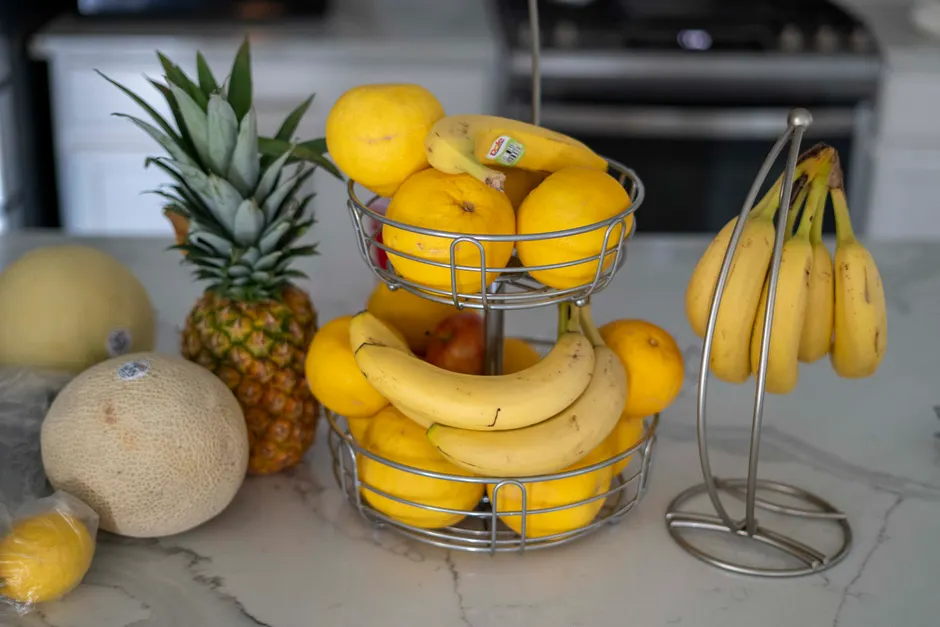
Les bananes sont-elles vraiment radioactives?

Oui, une banane contient bien du potassium-40, un isotope naturellement radioactif. Mais ce détail exact ne transforme pas le fruit en mini-réacteur. Pour trancher, il faut séparer activité radioactive, dose reçue et danger sanitaire.
Le seul indice vrai : le potassium-40

Les bananes sont riches en potassium, un élément impliqué dans le fonctionnement des muscles, des nerfs et l’équilibre des fluides. Le potassium naturel existe sous plusieurs formes, appelées isotopes. Une petite fraction, environ 0,012 %, est du potassium-40, ou K-40, qui se désintègre spontanément.
Le K-40 est présent naturellement dans la banane, comme dans de nombreux aliments et dans le corps humain. Il ne s’agit donc pas d’une contamination venue d’une centrale, d’un accident nucléaire ou d’un cargo suspect. Le bananier absorbe du potassium dans le sol, avec la proportion habituelle de K-40.
La période radioactive du K-40 est d’environ 1,3 milliard d’années. Cette désintégration très lente explique la faible activité du fruit. Une banane moyenne contient environ 450 milligrammes de potassium et présente une activité de l’ordre d’une quinzaine de becquerels. Un becquerel correspond à une désintégration par seconde. Le chiffre varie avec la taille et la composition du fruit, sans changer le diagnostic.
Radioactive ne signifie pas contaminée
Le mot « radioactive » évoque vite une centrale ou un accident. Pourtant, la radioactivité naturelle existe dans les sols, les roches, l’air, l’eau et les êtres vivants. La banane n’a pas décroché un badge de mini-réacteur : elle contient une quantité infime d’un isotope présent dans la nature.
Une étude publiée en 2021 dans Scientific Reportsintitulée In-situ assessment of natural terrestrial-radioactivity from Uranium-238 (238U), Thorium-232 (232Th) and Potassium-40 (40K) in coastal urban-environment and its possible health implicationsa mesuré la radioactivité naturelle d’un environnement urbain côtier du sud-ouest du Nigeria. Elle ne portait pas sur des bananes et ne permet donc pas d’en déduire un risque pour les consommateurs. Elle documente toutefois la présence du K-40 dans les milieux naturels.
Becquerel et sievert : le chiffre ne raconte pas tout
Le piège de la légende est de transformer une mesure d’activité en diagnostic de danger. Or un nombre de becquerels ne suffit pas à évaluer une exposition. Il faut aussi considérer le rayonnement émis, son énergie, la quantité absorbée et la durée de l’exposition.
Les comparaisons de vulgarisation situent généralement la dose associée à une banane autour de 0,1 microsievert, avec des variations selon le fruit et le calcul retenu. Cette dose est très faible par rapport à l’exposition naturelle reçue chaque jour. Un détecteur qui réagit à une banane mesure un phénomène réel, pas une menace nucléaire.
La « Banana Equivalent Dose », ou dose équivalente en bananes, donne une image concrète de doses minuscules. Elle n’est toutefois pas une unité officielle du Système international. Elle ne remplace ni le becquerel ni le sievert et ne permet pas de comparer mécaniquement toutes les expositions.
Le potassium-40 ne s’ajoute pas indéfiniment dans l’organisme à chaque bouchée. Le corps régule le potassium et élimine progressivement l’excédent. La radioactivité d’une banane ne s’accumule donc pas comme un déchet industriel.
La banane n’a pas le monopole du phénomène

La banane est devenue l’exemple vedette parce qu’elle est courante et riche en potassium. Elle n’est pourtant pas seule dans cette affaire. Les pommes de terre, les haricots, les noix et d’autres aliments contenant du potassium renferment eux aussi une petite quantité de K-40. La banane a surtout remporté le concours de l’anecdote la plus facile à retenir.
Une étude publiée le 1er mars 2023 dans Radiation Protection DosimetryAssessment of Doses from Ingestion of Naturally Occurring Radionuclides K-40 and Ra-226 in Rice Consumed in Taiwana examiné 30 échantillons de riz vendus sur des marchés taïwanais, dont 24 échantillons locaux et 6 importés. Les chercheurs ont estimé à 6,80 microsieverts par an la dose liée au K-40 dans le riz étudié. La dose combinée du K-40 et du radium-226 atteignait 14,66 microsieverts par an, contre une moyenne mondiale de 290 microsieverts par an pour l’exposition par ingestion de sources naturelles.
Cette étude ne donne pas la dose d’une banane. Elle montre plutôt la méthode : mesurer l’activité des radionucléides, estimer la quantité consommée, puis calculer la dose correspondante. Un résultat obtenu sur du riz ne se transpose pas automatiquement à un autre aliment.
Le raccourci qui fait tourner la légende

La légende part d’un fait vrai : la banane contient du K-40. Le raccourci ajoute ensuite une conclusion qui n’est pas démontrée : si le fruit est radioactif, il serait dangereux. Entre les deux, il manque la question décisive de la dose. Une belle histoire, un mauvais dossier.
Le format de la phrase favorise sa circulation. « Les bananes sont radioactives » est court, surprenant et facile à répéter. À chaque partage, la précision sur la faible dose peut disparaître tandis que le mot le plus spectaculaire reste en place. La légende avance alors comme un jeu de téléphone arabe : une mesure devient une alerte, puis une alerte ressemble à une preuve.
Le biais de confirmation entre en scène
Le biais de confirmation renforce le mécanisme. Une personne qui associe déjà la radioactivité aux centrales, aux explosions ou aux accidents retiendra plus facilement le mot inquiétant que les informations sur le K-40 naturel et la dose minime. La viralité du récit ne constitue pas une preuve de sa conclusion.
Le mot « naturel » ne suffit pas à rendre une substance inoffensive, pas plus que le mot « artificiel » ne suffit à la rendre dangereuse. Le risque dépend de l’exposition et de la dose, pas seulement de l’origine du rayonnement. Dans le cas d’une banane consommée normalement, les éléments disponibles conduisent à une réponse beaucoup moins spectaculaire que la légende.
Le verdict : un fruit radioactif, pas un aliment dangereux

La réponse comporte donc deux volets. Oui, les bananes sont légèrement radioactives à cause du potassium-40. Non, cette radioactivité naturelle ne signifie pas qu’elles sont contaminées ou dangereuses dans le cadre d’une consommation normale.
Sources et références scientifiques
- In-situ assessment of natural terrestrial-radioactivity from Uranium-238 (238U), Thorium-232 (232Th) and Potassium-40 (40K) in coastal urban-environment and its possible health implications – PMC. Scientific reports. DOI: 10.1038/s41598-021-96516-z · PMID: 34475416.
- 1.UNSCEAR. United Nations Scientific Committee on the effects of atomic radiation. Sources, effects and risk of ionising radiation, Report to the General Assembly, United Nations, New York (2000)..
- 2.USEPA. 1993. Reference Dose (RfD): Description and Use in Health Risk Assessments Mar 1993. [DOI] [PubMed].
- 3.Guagliardi I, Rovella N, Apollaro C, Bloise A, Rosa RD, Scarciglia RF, Gabriele Buttafuoco G. Effects of source rocks, soil features and climate on natural gamma radioactivity in the Crati valley (Calabria, Southern Italy) Chemosphere. 2016;150:97-108. doi: 10.1016/emosphere.2016.02.011. [DOI] [PubMed] [Google Scholar]. doi:10.1016/j.chemosphere.2016.02.011.
- 4.Shahbazi-Gahrouei D, Setayandeh S, Gholami M. A review on natural background radiation. Adv. Biomed. Res. 2013;2(1):65. doi: 10.4103/2277-9175.115821. [DOI] [PMC free article] [PubMed] [Google Scholar]. doi:10.4103/2277-9175.115821.
- 5.NRC, Committee on Evaluation of EPA Guidelines for Exposure to Naturally Occurring Radioactive Materials. Evaluation of Guidelines for Exposures to Technologically Enhanced Naturally Occurring Radioactive Materials. National Academies Press, Washington, DC (1999). [PubMed].
- 6.NRC, Radiation protection and the Nuclear Regulatory Commission. U.S. Nuclear Regulatory Commission Washington, D.C. 20555-0001 Office of Public Affairs, NUREG/BR-0322, pp 1-8 (2006)..
- 7.Omeje M, Wagiran H, Joel ES, Kayode OT, Adewoyin OO. Radioactivity and radiological impact assessment in ota-dumping site, Ogun State, Nigeria. Sci. Int. (Lahore) 2016;28(2):1883-1887. [Google Scholar].
- 8.UNSCEAR, Report of the United Nations Scientific Committee on the Effects of Atomic Radiation. Fifty-seventh sessions, includes Scientific Report: summary of low-dose radiation effects on health. United Nations, New York (2010)..
- 9.UNSCEAR, Sources, effects and risk of ionising radiation. Report to the general assembly, with scientific annexes (A and B), United Nations, New York (2012)..
- 10.Al Nabhani K, Khan F, Yang M. Technologically enhanced naturally occurring radioactive materials in oil and gas production: A silent killer. Process Saf. Environ. Protect. 2016;99:237-247. doi: 10.1016/j.psep.2015.09.014. [DOI] [Google Scholar]. doi:10.1016/j.psep.2015.09.014.
- 11.Alazemi N, Bajoga AD, Bradley DA, Regan PH, Shams H. Soil radioactivity levels, radiological maps and risk assessment for the state of Kuwait. Chemosphere. 2016;154:55-62. doi: 10.1016/emosphere.2016.03.057. [DOI] [PubMed] [Google Scholar]. doi:10.1016/j.chemosphere.2016.03.057.
- 12.Bangotra P, Mehra R, Jakhu R, Kaur K, Pandit P, Kanse S. Estimation of 222Rn exhalation rate and assessment of radiological risk from activity concentration of 226Ra, 232Th and 40K. J. Geochem. Explor. 2018;184:304-310. doi: 10.1016/j.gexplo.2017.05.002. [DOI] [Google Scholar]. doi:10.1016/j.gexplo.2017.05.002.
- First-in-Human Study of 18F-Labeled PET Tracer for Glutamate AMPA Receptor [18F]K-40: A Derivative of [11C]K-2 – PMC. Journal of nuclear medicine : official publication, Society of Nuclear Medicine. DOI: 10.2967/jnumed.124.269405 · PMID: 40341090.
- 1. Malinow R, Malenka RC. AMPA receptor trafficking and synaptic plasticity. Annu Rev Neurosci. 2002;25:103-126. [DOI] [PubMed] [Google Scholar].
- 2. Kessels HW, Malinow R. Synaptic AMPA receptor plasticity and behavior. Neuron. 2009;61:340-350. [DOI] [PMC free article] [PubMed] [Google Scholar].
- 3. Zhao Y, Chen S, Swensen AC, Qian WJ, Gouaux E. Architecture and subunit arrangement of native AMPA receptors elucidated by cryo-EM. Science. 2019;364:355-362. [DOI] [PMC free article] [PubMed] [Google Scholar].
- 4. Herguedas B, Watson JF, Ho H, Cais O, García-Nafría J, Greger IH. Architecture of the heteromeric GluA1/2 AMPA receptor in complex with the auxiliary subunit TARP gamma8. Science. 2019;364. [DOI] [PMC free article] [PubMed] [Google Scholar].
- 5. Jitsuki S, Takemoto K, Kawasaki T, et al. Serotonin mediates cross-modal reorganization of cortical circuits. Neuron. 2011;69:780-792. [DOI] [PMC free article] [PubMed] [Google Scholar].
- 6. Abe H, Jitsuki S, Nakajima W, et al. CRMP2-binding compound, edonerpic maleate, accelerates motor function recovery from brain damage. Science. 2018;360:50-57. [DOI] [PubMed] [Google Scholar].
- 7. Takahashi T, Svoboda K, Malinow R. Experience strengthening transmission by driving AMPA receptors into synapses. Science. 2003;299:1585-1588. [DOI] [PubMed] [Google Scholar].
- 8. Takemoto K, Iwanari H, Tada H, et al. Optical inactivation of synaptic AMPA receptors erases fear memory. Nat Biotechnol. 2017;35:38-47. [DOI] [PubMed] [Google Scholar].
- 9. Aleksandrova LR, Phillips AG, Wang YT. Antidepressant effects of ketamine and the roles of AMPA glutamate receptors and other mechanisms beyond NMDA receptor antagonism. J Psychiatry Neurosci. 2017;42:222-229. [DOI] [PMC free article] [PubMed] [Google Scholar].
- 10. Chang PK-Y, Verbich D, McKinney RA. AMPA receptors as drug targets in neurological disease: advantages, caveats, and future outlook. Eur J Neurosci. 2012;35:1908-1916. [DOI] [PubMed] [Google Scholar].
- 11. Sato M, Kawashima Y, Goto J, et al. Synthesis and evaluation of novel fluorinated sulotroban-related sulfonamide derivatives as thromboxane A2 receptor antagonists. Eur J Med Chem. 1995;30:403-414. [Google Scholar].
- 12. Fu H, Chen Z, Josephson L, Li Z, Liang SH. Positron emission tomography (PET) ligand development for ionotropic glutamate receptors: challenges and opportunities for radiotracer targeting N-Methyl-d-aspartate (NMDA), α-amino-3-hydroxy-5-methyl-4-isoxazolepropionic acid (AMPA), and kainate receptors. J Med Chem. 2019;62:403-419. [DOI] [PMC free article] [PubMed] [Google Scholar].
- Genetic Diversity Analysis of 96 Gossypium hirsutum-Gossypium barbadense Introgression Lines and Early Maturing Northern China Cotton Lines Using a 40K Liquid-Phase Chip – PMC. Genes. DOI: 10.3390/genes17040388 · PMID: 42074505.
- 1.Wang C., Liu J., Xie X., Wang J., Ma Q., Chen P., Yang D., Ma X., Hao F., Su J. GhAP1-D3 positively regulates flowering time and early maturity with no yield and fiber quality penalties in upland cotton. J. Integr. Plant Biol. 2023;65:985-1002. doi: 10.1111/jipb.13409. [DOI] [PubMed] [Google Scholar]. doi:10.1111/jipb.13409.
- 2.Wang C., Yuan W., Liu J., Xie X., Ma Q., Ju J., Chen D., Wang N., Feng K., Su J. Comprehensive Evaluation and Breeding Evolution of Early Maturing Upland Cotton Varieties in the Northwest Inland of China. Sci. Agric. Sin. 2023;56:1-16. doi: 10.3864/j.issn.0578-1752.2023.01.001. [DOI] [Google Scholar]. doi:10.3864/j.issn.0578-1752.2023.01.001.
- 3.Han B., Zhang W., Wang F., Yue P., Liu Z., Yue D., Zhang B., Ma Y., Lin Z., Yu Y. Dissecting the Superior Drivers for the Simultaneous Improvement of Fiber Quality and Yield Under Drought Stress Via Genome-Wide Artificial Introgressions of Gossypium barbadense into Gossypium hirsutum. Adv. Sci. 2024;11:2400445. doi: 10.1002/advs.202400445. [DOI] [PMC free article] [PubMed] [Google Scholar]. doi:10.1002/advs.202400445.
- 4.Grover C.E., Jareczek J.J., Swaminathan S., Lee Y., Howell A.H., Rani H., Arick M.A., Leach A.G., Miller E.R., Yang P. A high-resolution model of gene expression during Gossypium hirsutum (cotton) fiber development. BMC Genom. 2025;26:221. doi: 10.1186/s12864-025-11360-z. [DOI] [PMC free article] [PubMed] [Google Scholar]. doi:10.1186/s12864-025-11360-z.
- 5.Tian Z., Zhang Y., Zhu L., Jiang B., Wang H., Gao R., Friml J., Xiao G. Strigolactones act downstream of gibberellins to regulate fiber cell elongation and cell wall thickness in cotton (Gossypium hirsutum) Plant Cell. 2022;34:4816-4839. doi: 10.1093/plcell/koac270. [DOI] [PMC free article] [PubMed] [Google Scholar]. doi:10.1093/plcell/koac270.
- 6.Guo C., Zhu L., Sun H., Han Q., Wang S., Zhu J., Zhang Y., Zhang K., Bai Z., Li A. Evaluation of drought-tolerant varieties based on root system architecture in cotton (Gossypium hirsutum L.) BMC Plant Biol. 2024;24:127. doi: 10.1186/s12870-024-04799-x. [DOI] [PMC free article] [PubMed] [Google Scholar]. doi:10.1186/s12870-024-04799-x.
- en M.-Z., Yang Y.-L., Wang Y.-X., Tian J.-S., Xu S.-Z., Liu N.-N., Dang K., Zhang W.-F. Plant type characteristics and evolution of main economic characters in early maturing upland cotton cultivar replacement in Xinjiang. Sci. Agric. Sin. 2019;52:3279-3290. doi: 10.3864/j.issn.0578-1752.2019.19.001. [DOI] [Google Scholar]. doi:10.3864/j.issn.0578-1752.2019.19.001.
- 8.Han Z., Hu Y., Tian Q., Cao Y., Si A., Si Z., Zang Y., Xu C., Shen W., Dai F. Genomic signatures and candidate genes of lint yield and fibre quality improvement in Upland cotton in Xinjiang. Plant Biotechnol. J. 2020;18:2002-2014. doi: 10.1111/pbi.13356. [DOI] [PMC free article] [PubMed] [Google Scholar]. doi:10.1111/pbi.13356.
- 9.Mao T.-y., Kong J., Hu S.-l., Zhang W., Chen J.-l., Li Y.-f., Wan S.-m., Chen G.-d. Morphological comparison of fiber development in different upland cotton varieties in southern Xinjiang. Xinjiang Agric. Sci. 2022;59:279-290. doi: 10.6048/j.issn.1001-4330.2022.02.003. [DOI] [Google Scholar]. doi:10.6048/j.issn.1001-4330.2022.02.003.
- 10.Wang Y.-J., Zhang H., Zhang B., Chang Y.-J., Gao W.-J., Geng S.-W., Chen Q., Chen Q.J. Genetic diversity analysis of 235 upland cotton materials phenotypic traits. Jiangsu J. Agric. Sci. 2023;39:636-644. doi: 10.3969/j.issn.1000-4440.2023.03.003. [DOI] [Google Scholar]. doi:10.3969/j.issn.1000-4440.2023.03.003.
- 11.Tang Z., Xie D., Yu Y., Fang W., Lu F. Evaluation of Inland Superior Cotton Resources and Their Application in Xinjiang Cotton Breeding. J. Henan Agric. Sci. 2024;53:37. doi: 10.15933/j.cnki.1004-3268.2024.02.004. [DOI] [Google Scholar]. doi:10.15933/j.cnki.1004-3268.2024.02.004.
- 12.Zhao Y., Zhu Y., Feng S., Zhao T., Wang L., Zheng Z., Ai N., Guan X. The impact of temperature on cotton yield and production in Xinjiang, China. npj Sustain. Agric. 2024;2:33. doi: 10.1038/s44264-024-00043-z. [DOI] [Google Scholar]. doi:10.1038/s44264-024-00043-z.
- Huang WH, Liu YY, Lin SC, Yeh YL, Chen TC.. ASSESSMENT OF DOSES FROM INGESTION OF NATURALLY OCCURRING RADIONUCLIDES K-40 AND RA-226 IN RICE CONSUMED IN TAIWAN.. Radiation protection dosimetry. 2023. DOI: 10.1093/rpd/ncac276 · PMID: 36588453. (résumé scientifique structuré; texte intégral non fourni)
- Marine Cestes. Les bananes sont-elles radioactives?. 2025.
- Jérémy Menet. Bananes radioactives | Dangereuses pour la santé?. 2025.
- Sarah Loughran, Director Radiation Research and Advice (ARPANSA), and Adjunct Associate Professor (UOW), University of Wollongong. Are bananas really 'radioactive'? An expert clears up common misunderstandings about radiation.
- ^ the Hulk ().
- ^ Radiation ().
- ^ background radiation ().
- ^ radiation” and “radioactivity ().
- ^ Explainer: the difference between radiation and radioactivity ().
- ^ Ionising radiation ().
- ^ Non-ionising radiation ().
- ^ Explainer: what is the electromagnetic spectrum? ().
- ^ can damage human tissues and DNA ().
- ^ Have you tested your home for cancer-causing radon gas? ().
- ^ if the person is exposed to sufficiently high intensity levels ().
- ^ International ().
- Leon. Les bananes sont-elles vraiment radioactives? Un mythe scientifique décortiqué. 2026.
